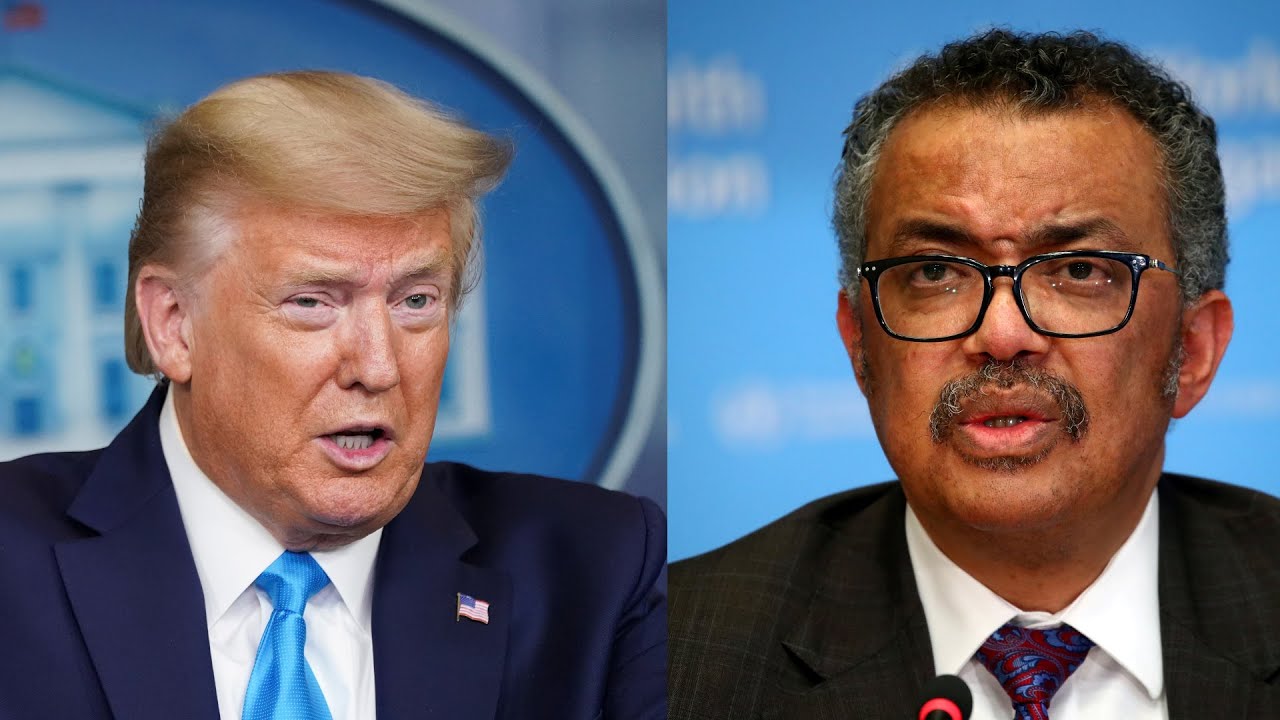
On May 19, U.S. President Donald Trump gave the World Health Organization an ultimatum: Start implementing reforms in 30 days or else the United States would halt funding for the international body. But 11 days after the pronouncement, Trump pulled the trigger anyway, abruptly declaring on Friday the United States would be “terminating” its relationship with WHO and cutting off the institution from any U.S. cash.
This didn’t come as a shocker as top Trump officials and Republican allies in Congress have been criticizing WHO for being too friendly with China and providing cover for Beijing in the wake of its initial cover-up and mishandling of the coronavirus outbreak.
“We have detailed the reforms that it must make and engaged with them directly, but they have refused to act,” Trump said in a press conference on Friday. “Because they have failed to make the requested and greatly needed reforms, we will be today terminating our relationship with the World Health Organization and redirecting those funds to other worldwide and deserving urgent global public health needs.”
An American withdrawal from the World Health Organization could wreak profound damage on the global effort to eradicate polio and could undermine the world’s ability to detect and respond to disease threats, health experts warned.
“The polio eradication program is very near completion, with many strong donors to it, and the U.S. has been one of the most faithful and strong. And it would be a shame not only for the United States, but for Rotary International, which has provided so much funding for that as well,” said Heymann, an American who heads a committee that advises the WHO’s health emergencies program.
If USA leaves the organization, which was established in 1948, the United States will give up an outsized role in the global health agency and the setting of global health priorities. While Trump has accused the WHO of kowtowing too much to China, in reality, experts acknowledge, other countries have sometimes bristled at how much sway the U.S. has at the Geneva-based agency.
“The U.S. has always had an extraordinary influence at the WHO — I mean to the extent that other countries have complained about American influence,” Ilona Kickbusch, a longtime former WHO official and chair of the Global Health Centre at the Graduate Institute of International and Development Studies in Geneva.
In fact, when the WHO underwent a series of reforms following its catastrophic early response to the 2014 West African Ebola outbreak — including setting up a permanent health emergencies program — a lot of the changes implemented were made at the behest of the United States, said Ashish Jha, director of Harvard’s Global Health Institute.
Despite the criticisms coming from Washington, U.S. efforts to influence the direction of WHO appear to have fallen flat. Trump’s announcement on Friday follows weeks of efforts by his ambassador to the Geneva-based organization, Andrew Bremberg, to prod WHO chief Tedros Adhanom Ghebreyesus into taking a tougher line with China. This included an unsuccessful U.S. push at an annual WHO meeting this month to get the institution to open an investigation into the origins of the virus in China and invite Taiwan back into the health agency as an observer knowing that China ardently opposes Taiwan’s participation in international organizations, seeing it as a sign of Taiwan’s sovereignty from Beijing.
 Theories and Insights